
How emuso Represents Music Constructs

Our core musical tools for assembling sounds are intervals. These are used to create scales and chords, the subject of the next lesson. Our core musical tools for applying these are rhythm-related; our choices for when and how long these sounds last for, which we use in melodies, and in chord progressions.
However, at this stage of learning about what can go in our musical toolbox, we shall completely ignore rhythm, so we can solely focus on what makes up a particular interval combination, why and how that combination is used, what it sounds like, and how it can be reproduced on your instrument. Of course, this is totally artificial.
As a tune plays, pitches from various instruments and singers combine to make various intervals. Various combinations come into existence briefly and then disappear. Imagine we record the tune, and then chop the recording up into lots of very short segments. Chances are a segment is either silent, or it holds only a few intervals combined at that time (of course, this is ignoring any shed-building via the drummer, or any incessant wailing from a harmonica. Come to think of it, either shoot the harmonica player or forget about any chance of a silent segment.)
The choices of intervals in any of these segments are very much governed by musical style. So, we want to look into, LITERALLY LOOK INTO, what these choices are. Certain intervals crop up over and over again, so you need to become familiar with these. To this end, emuso provides a very simple visualisation of intervals and their combinations, be that for an interval in isolation, or a pattern of intervals, or further choices made out of the pattern. This tool is the clock face. It is deceptively powerful, yet very quick to master.
Patterns you see on the clock are immediately transferrable onto your instrument … line up 0 AM (midnight) with your solid red circle (the anchor) and the rest must follow (this is covered below). We don’t want to distract your attention towards notation. We want to keep you focused on the interval pattern under discussion or practice.
In this lesson, you will learn how to pretty much instantly identify different intervals by sight, purely by looking at the spacing between circles placed at different “times” on the clock. In particular, you will be able to recognise intervals of 3, 4, 7, 10 and 11 semitones by sight. These intervals lie at the heart of huge numbers of tunes.
Why use a clock analogy?
The clock is a very well-known symbol. The only difference between an emuso clock and a standard one is how we talk about time 0 AM (zero AM) rather than 12 AM. So you should feel comfortable if I say “look at the coloured circle at 7 AM”, and immediately know where to look at the clock.

Here are the other main reasons:
- Western music divides the octave into twelve semitones. The clock has twelve time positions on it.
- The time 0 AM always models the pitch found at the solid red circle, the anchor, on-instrument.
- The times 1 to 11 AM model the remaining eleven semitones from the anchor pitch.
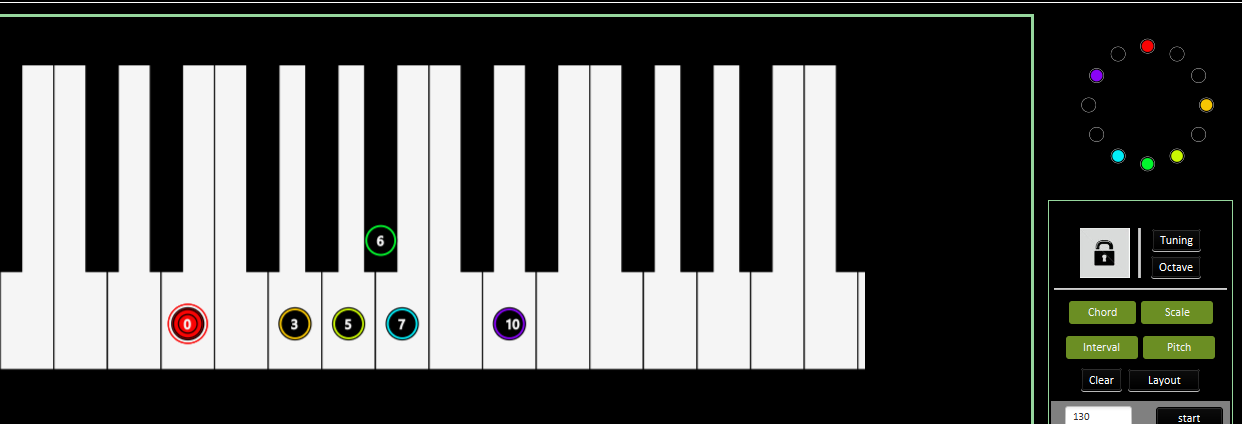
- The colour system used in emuso is identical for pitches shown on-instrument and pitches shown on the clock. For example, with the default colour scheme, the blue colour (7 AM) denotes 7 semitones, and you can see a blue-rimmed circle on-instrument, 7 semitones above the anchor pitch. This is especially obvious on piano, or if we just use one string of a stringed instrument.
- The clock visually lends itself to the ease of recognition of “distances” between (occupied) times.
Pattern transfer from clock to an instrument
Let’s have a look. Below is a pattern much beloved by blues players. Look at the clock pattern, and observe where the times are occupied, and where they are not. Look at the instrument. If necessary, keep pressing the computer keyboard letter ‘i’ (lowercase) until the labelling on-instrument matches the diagram. Can you see how the pattern on-instrument starts at the anchor, and then exactly matches the clock? See how the unoccupied times translate to “gaps” on the instrument. Look at 3 AM. Look at the pitch on-instrument that is 3 semitones above the anchor. See it is labelled 3 and coloured the same? And of course, you can move this pattern wherever you like just my moving the anchor. Try changing to a string instrument. On guitar, bass, and violin, you will see the pattern extending into other octaves.

Visual recognition of intervals on a clock
The reason for learning this is you will able to look at a pattern, say for a chord, and quickly assess the number of semitones from the chord root to each of the other members of the chord. This gives you the intervals contained in that chord. We shall try this below.
From whichever time you choose, moving clockwise by one hour is equivalent to an increase of 1 semitone in pitch. If you move 12 hours clockwise, you end up back at your start choice. The name of the game is to be able to look at any occupied time, and some other occupied time further round the clock, clockwise, and visually measure the number of hours (semitones) to the latter occupied time.
- When the first time is located at 0 AM, just read the other time straight off the clock. Otherwise…
- When this difference is small, that is, 1, 2, 3, or 4 hours difference, then these “gaps” can easily be recognised.
- When the difference is 5, 6, or 7 hours, a different approach can be used, based on visually locating the time diametrically opposite the one you’re measuring from (which is always 6 hours away), and then adjusting from there.
- When the difference is 10 or 11 hours, a different approach is simply to look back counterclockwise by 2 or 1 hours respectively.
- This leaves differences of 8 and 9 hours. These take the most effort to recognise visually.
Let’s start with this example…
3 and 4 semitones
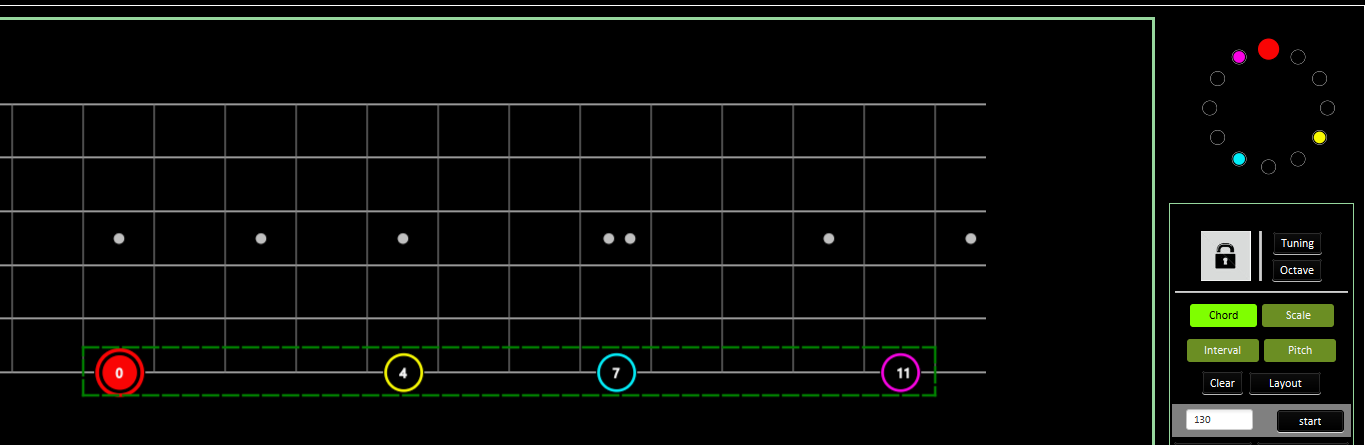
These are very easy to recognise. You want to look for a gap of two or three hours respectively. Look at the first of the two examples above.
Suppose we are interested in the pitches at 0 AM and 4 AM. Apart from the convenience of just reading the time (4 AM) to know that this represents a pitch 4 semitones above the anchor, you can also quite easily see a gap of 3 unfilled circles. If there’s a gap of three before the time of interest, in total the time must be one further than the gap size, so 4 hours away.
Next, suppose we are interested in the times 7 and 11. Here’s the same visual gap (3 unfilled circles).
Next, look at the times 4 and 7. Look at the gap here. This is very simple to spot (2 unfilled circles). A gap of 2 before the time of interest means the total time difference is one bigger … 3 hours (3 semitones).
11 semitones
Look at 0 AM and 11 AM in the first example. Visually, rather than going clockwise by 11 hours, the same time can be arrived at by going counterclockwise by one hour.
7 semitones
Look at 0 AM and 7 AM. Imagine a line from 0 AM to its opposite time at 6 AM. Move clockwise 1 hour for 7 semitones. Move back 1 hour for 5 semitones.
In all, we found, measuring from 0 AM, that we have time differences (semitones) of (0, 4, 7 and 11). Later on, you’ll discover that such a pattern is a chord, known as a major 7th, The point, for now, is that you extracted the pattern, visually.
Now we’ll use an example where we start measuring from somewhere other than 0 AM.
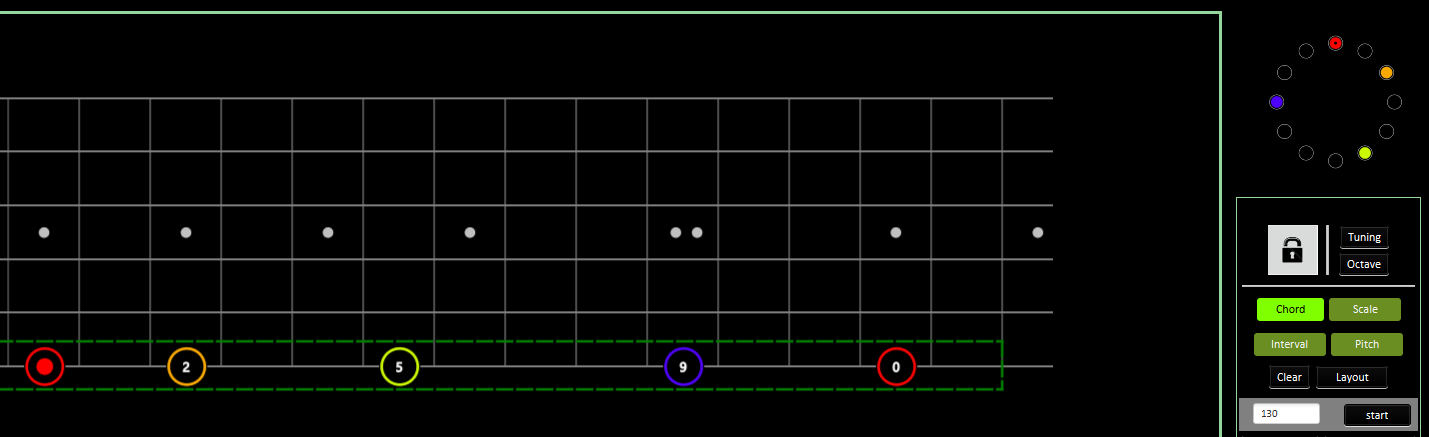
This time, we’ll measure from 2 AM. See the two circle gap between 2 AM and 5 AM? So, the times of 2 AM and 5 AM represent an interval of three semitones. Next, between 5 AM and 9 AM, there is a 3 circle gap. So, these two times at 5 AM and 9 AM make an interval of 4 semitones (one bigger than the gap). Equally, look from 2 AM to it’s opposite (8 AM). This is 6 semitones. Move clockwise one hour clockwise to the circle of interest at 9 AM. Therefore the interval between 2 AM and 9 AM is visually 7 semitones (6 + 1). And of course, the maths confirms that (2 + 7 = 9)!
What about from 2 AM all the way clockwise around to 0 AM again? This is 10 semitones, but we can avoid counting this by moving counterclockwise by 2 hours back to 0 AM.
So, measuring from 2AM, we’ve found an interval pattern of (0, 3, 7, 10). Later you’ll see this is the pattern for a chord known as a minor 7.
Scale patterns
Often, we’ll be looking at a scale pattern, and then looking for chords within a scale, by doing very similar to the above. Often, we’ll look at some occupied time, and try and skip over 2 or 3 semitones to see if we land on another occupied time. In these cases, the segment of the clock we are skipping over may well hold occupied times too, but we ignore these. Even so, it should still be simple to skip over these, by recognising how much space they take up visually. These small segments, in particular, are especially important to recognise, because so many chords are built with pitches that are some mixture of 3 and 4 semitones apart (and hence have small segments of 2 or 3 hours between them).
Test
Which times (colours) below, have 2 hour gaps between them on this following clock?
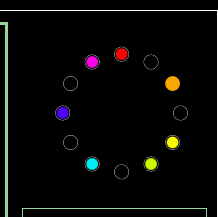
Answer: (2, 5); (4,7); and (9,0).
Which times have a gap of three semitones between them?
Answer: (0, 4), (5,9)? and (7, 11).
For this next assignment, Ignore all tiny segments of 0 or 1 times between occupied pitches. We’re looking for bigger ones.
Starting at 9 AM, and moving clockwise (including across 0 AM), look for a segment of two or greater before landing on another occupied time. What time is occupied after the segment?
Answer: (0AM). The segment is 2 hours long (10, 11). Therefore from 9 AM to 0 AM is 3 semitones.
Where else can you find segments that are two hours long? What are the times on either side of any such segment?
Answer: (2 AM, 5 AM). (4 AM, 7? AM).
Which times on the clock form an interval of 3 semitones with another occupied time?
Answer:?2 AM, 4 AM, and 9 AM.
You may remember that the combination of (0, 3 and 7) semitones is the pattern of intervals in a minor triad? So, it looks like we may have minor triads found from 2, 4, and 9 semitones above the anchor. We’d have to check to see if there is also an interval of 7 semitones from each of these times, to confirm we really do have minor triads.
Summary
By developing visual skills at recognising various gaps on the clock it becomes quickly possible to assess an interval pattern found within a larger pattern on the clock. Musically, you’ll see in the next lesson that this corresponds to recognising different chord types being found within a scale.


