
Exploring Triads in the Major Scale

In this lesson, you’ll apply what you know about triads, to search for them in a collection of intervals known as the major scale. You will discover that there are three major triads, three minor triads, and one diminished triad, that can be created out of the major scale. You will also get a look at how emuso shows relationships, like chords in a scale, using the clock measurer tool that visualises these relationships for you. Finally, you’ll make some major scale chord progressions.
Prequisites
Make sure you’ve tried out the lessons on major and minor triads.
Recap of the Major. Minor and Diminished Triad Intervals
- major triad has intervals 1, 3, 5
- minor triad has intervals 1, b3, 5
- diminished triad has intervals 1, b3, b5
Creating the major scale
Here you will be asked to create the intervals of 0, 2, 4, 5, 7, 9 and 11 semitones along one string with your choice for the anchor. This pattern of intervals (and its octaves) is called the major scale, for short. For now, make sure the instrument and interval strip labelling show numbers 0 – 11 (that is, shows semitones) … press the keyboard key “i” until you see this.

Next, here is the same idea, but instead of clicking on the instrument, you will click on clock times 0, 2, 4, 5, 7, 9 and 11. Make the clock large, by pressing the “Large clock…” button when this exercise starts. Make sure to press ‘i’ so labels on the clock and interval strip and instrument show 0 – 11 (that is, semitones)
You’ve just seen that there is a major triad rooted off the first pitch of the scale (at zero semitones from the anchor … coincident with the anchor). You also saw there is a minor triad whose root is at the second pitch of the major scale. Now you’ll learn some more about how to explore for chords embedded in a scale (similar to what you’ve just done), using a tool called Rel-X
Rel-X
Here we’ll look for major and minor triads in the major scale.
- Enter the toolkit
- Click “Large clock…”
- Click “Scale>Major”
- Type “=” so the labels on the scale show 0 to 11
- Click “Rel-X” button on the large clock
- Click “Choose search” and select “from Chord menu”
- Click “Chord>Maj Triad”
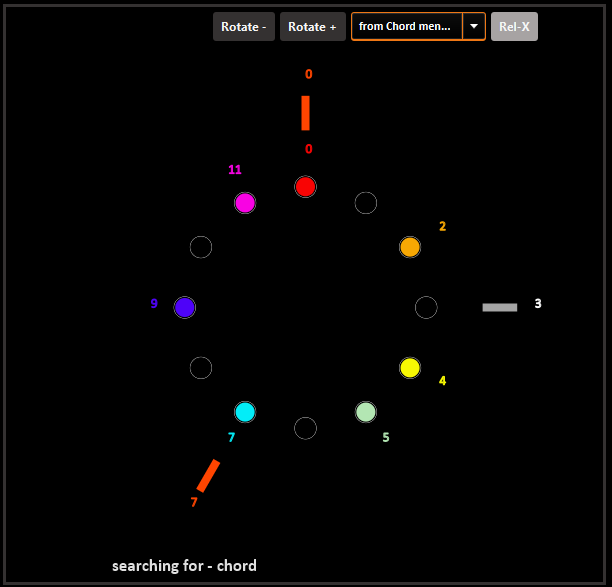
- Observe at what clock times all three spokes on the wheel are highlighted orange-red
- Click “Rotate+” or “Rotate-” to rotate the spokes, and each time a match occurs, not the time on the clock the match starts at. Look for the spoke whose outer text label is “0”.
You will have found the major triad matched when located at (rooted at) semitones 0, 5 and 7 of the scale, as shown on the clock.
Type “=” again, and the labelling now changes to interval symbols. Do the rotations again, and you’ll see the major riad aligns with intervals 1 (the scale tonic), 4, and 5. (also know as scale degrees 1, 4, and 5).
Repeat the above, but this time, choose “Chord > Min Triad”.
You’ll see this… the chord is initially aligned at clock time 0. Notice the mismatch at semitone 3 of the clock. Go through the rotations again, and you will find matches at semitones 2, 4 and 9 of the clock. (using interval symbols, 2, b3, and 6)
Barre chord
A barre chord is a chord using all six strings, where the first finger is pressed down flat across the neck behind a fret, holding down all the strings at the fret. The guitar nut does the same job for us at fret zero. Beginners frequently struggle with this, especially if the guitar has a high action (that is, the underside of the strings aren’t that close to the top of the frets) or heavy strings (making it harder to press down).
This is why in the previous lessons on major and minor triads we started using triads, just on the top three strings as they are easier to play, while sounding great.
Triad chord progressions from the major scale
Here’s a rock chord progression, using progression roots at semitones from the key centre of 9, 7, 5? 5, 4, 2, 2, 2, 7.
Here’s the same progression, but using different inversions of the triads in the same area of the neck. Does it have a different feel as a result?
Putting the above music together
Here is a video showing how one of the above rhythm-X examples was made, employing the inv-X inversion tool. emuso actually has two different inversion tools. One, where you use the Left Arrow, Right Arrow, Up Arrow, and Down Arrow, on the keyboard just inverts a pattern purely based on what the pattern contains. The other one, inv-X, understands how to shift patterns to use the correct intervals to keep each inverted pitch within the scale. When a scale is on the instrument, you can type a number 2 to 7 to indicate that, if you use the X-inverter by pressing the “[” or “]” key, then any selected pattern on-instrument will be moved by a “generic” 2nd or a 3rd and so on. When a 2nd is selected, as the pattern is shifted, each pitch will get moved by one or two semitones so that the result is still in the scale. The theory is not that important for now, but you can have fun exploring with both these inverters.
Summary
You’ve know seen that there are major triads rooted at 0, 5, and 7 semitones from the major scale keynote. There are minor triads rooted at 2, 4 and 9 semitones from the major scale keynote.
Next


